How Does Google Ads for Therapists Perform Differently for Telehealth vs. In-Person Practices?
Both in-person clinics and virtual practices use Google Ads for Therapists to attract new intakes, but the two run on fundamentally different mechanics. A strategy that fills a local office will often fail when applied to a statewide telehealth practice, and vice versa. Geographic reach, keyword intent, competition, and conversion rates all shift depending on how you deliver care, and your campaign structure should reflect that.
The short answer: in-person therapy campaigns target a tight local radius, attract proximity-based searches like "therapist near me," and typically convert at higher rates. Telehealth campaigns target entire states, reach far more searchers, and face heavier competition from national platforms, so they depend on niche keywords and a frictionless online intake process.
Telehealth vs. In-Person Google Ads: Key Performance Differences
Here is how the two practice models compare across the metrics that matter most in a Google Ads for Therapists campaign:
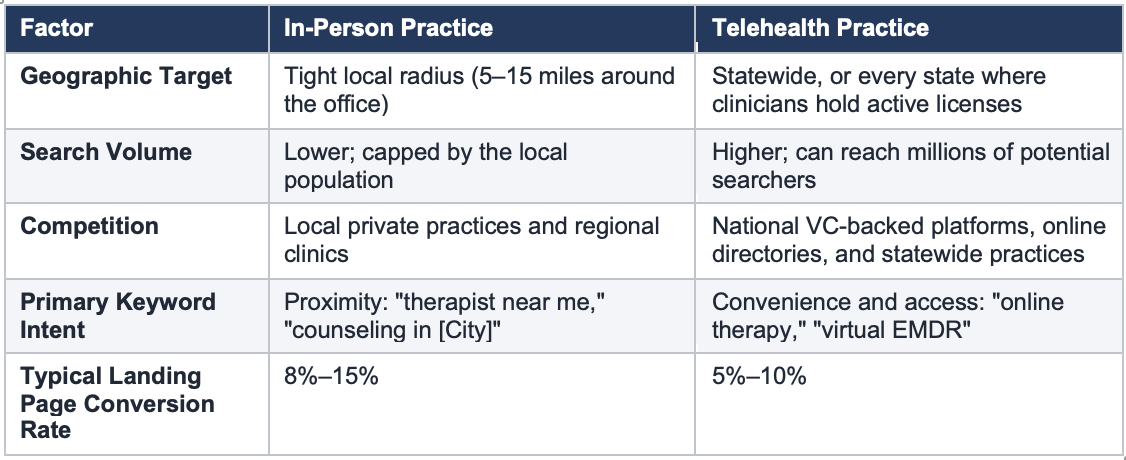
In-person landing pages tend to convert better because of physical proximity and local trust. Telehealth pages can close the gap, but only with a fast, simple digital intake. Keep in mind that these benchmarks only mean something if you are measuring real leads; if your account counts page views as conversions, your numbers will look far better than your caseload. Learn more about the difference between good and bad conversion tracking.
Geographic Targeting: Local Radius vs. Statewide Reach

Geographic configuration is the primary technical distinction between in-person and telehealth campaigns.
In-Person Practices: Tight Radius Targeting
Most clients are unwilling to commute more than 20 to 30 minutes for a weekly appointment. Setting a radius target, such as 10 miles around your office address, ensures every dollar reaches searchers who can realistically visit you. Because the footprint is small, total monthly search volume is limited, but lead relevance is exceptionally high. Local market conditions matter too; see how location changes Google Ads for Therapists in major metros, and how campaigns perform in small towns and rural areas.
Telehealth Practices: Statewide Targeting
Telehealth campaigns expand targeting to the entire state, or states, where your clinicians hold active licenses. This increases available search volume, but it also exposes your ads to a much larger pool of competitors. Without negative keywords and a well-planned budget, high-volume metropolitan areas can consume your daily spend before your ads ever reach the rest of the state. If that is happening, it may be a sign your Google Ads budget is too low to compete.
Pro tip: In your location settings, choose "Presence: People in or regularly in your included locations" rather than the default that also includes people merely searching about the area. Because clients generally need to be physically located in a state where you are licensed, this keeps your telehealth budget focused on people you can legally treat.
Keyword Intent: How In-Person and Telehealth Clients Search

How someone phrases a search reveals whether they prefer a couch or a screen. Matching your keywords to that search intent is what separates qualified leads from wasted clicks.
In-Person Search Behavior
Clients seeking in-person therapy focus on location and physical access. They use phrases such as "therapist near me," "couples counseling in [City]," or "walk-in therapy clinic." Ad copy for in-person practices should highlight neighborhood markers, easy parking, a comfortable office environment, and your clinic location.
Telehealth Search Behavior
Clients seeking telehealth prioritize convenience, fast scheduling, and remote access. They use phrases such as "online therapy for anxiety," "telehealth EMDR therapist," or "virtual counseling covered by insurance." Ad copy for telehealth practices should emphasize flexible appointments and seamless digital onboarding.
For both models, remember that Google restricts how health conditions can appear in ad text. Let your keywords target the specialty and keep condition names out of your headlines; our guide to Google's Health in Personalized Advertising policy explains how.
Competitive Dynamics: Local Peers vs. National Telehealth Platforms
In-person practices primarily compete with neighboring private practitioners, group practices, and local mental health agencies, so bidding costs stay tied to local market density.
Telehealth practices face a different kind of competition. In addition to local peers, virtual ads compete directly with large national telehealth platforms and directory sites backed by massive monthly budgets. These platforms bid aggressively on broad terms like "online counseling."
To compete without overspending, avoid hyper-generic terms like "online therapy." Instead, focus on niche, condition-specific phrases combined with virtual modifiers, such as "virtual ERP therapy for OCD" or "online trauma therapist in [State]." Specific keywords paired with a matching landing page also tend to earn a stronger Quality Score, which lowers your cost per click. If you are launching a new service line, see how to fill a new specialty fast with Google Ads.
How Should Hybrid Practices Structure Google Ads for Therapists?
If your practice offers both in-person and telehealth appointments, do not combine them into a single campaign. Build two separate campaigns so you can manage budgets and location settings independently:
Campaign 1 (In-Person Local): Targets a local radius around your office. Uses location-based keywords like "anxiety therapist near me" and sends traffic to a landing page featuring office photos, directions, and your address.
Campaign 2 (Statewide Telehealth): Targets your entire licensed state, excluding or adjusting bids for your local radius. Uses virtual keywords like "online trauma therapy" alongside general, non-online terms, and sends traffic to a telehealth-specific landing page with a streamlined online intake form.
This dual-campaign structure prevents your statewide telehealth campaign from stealing budget from your physical location, so both service lines stay consistently filled. Group practices with multiple clinicians or offices can take this further; read Google Ads for group practices: one campaign or multiple? And before launching either campaign, run through our checklist of what a therapist's website needs before running Google Ads.
Frequently Asked Questions
-
Often, yes, on broad terms. Telehealth ads compete with national platforms that bid heavily on generic keywords like "online therapy." Focusing on niche, condition-specific, state-level keywords keeps costs manageable.
-
You should only target states where your clinicians hold active licenses. Advertising elsewhere wastes budget on clients you cannot legally see and can create compliance problems.
-
Yes. In-person pages should feature your office, address, and directions, while telehealth pages should emphasize flexible scheduling and a simple online intake. Sending both audiences to one generic page is a common reason practices get clicks but no leads.
-
Most campaigns need a 30 to 90 day learning phase to gather data and optimize. Learn more about how long it takes to see results from Google Ads for Therapists.
Build a Google Ads for Therapists Strategy That Matches How You Deliver Care
Aligning your campaign structure with your practice model prevents wasted spend and connects you with clients looking for your specific format of care. Whether you run a local office, a statewide telehealth practice, or a hybrid of both, RevKey designs Google Ads for Therapists campaigns built around how mental health professionals actually work.
Schedule a free consultation to review your current telehealth, in-person, or hybrid campaign setup.
Meet with RevKey's Google Ads specialists to build separate targeting, keyword, and budget strategies for each service line.
Start filling your calendar with clients who are actively searching for the way you deliver care.
Sam D'Andrea, Google Ads Account Manager
Sam D'Andrea is a digital marketing strategist at RevKey, specializing in Google Ads, paid media optimization, and data-driven growth strategies. With hands-on experience managing and testing evolving campaign types, Sam focuses on helping businesses generate higher-quality leads through smart automation, strong audience signals, and accurate conversion tracking. At RevKey, Sam works closely with clients to translate Google's constant platform changes into clear, effective advertising strategies that drive real results.